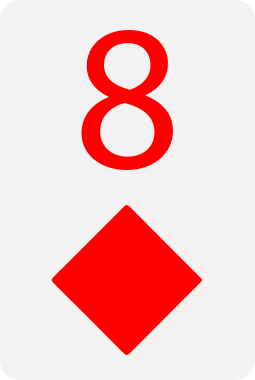
Pocket Eights is a hand that sits at one of the most psychologically challenging points in the poker hand rankings. It is strong enough to be a clear favourite over any unpaired hand before the flop, yet weak enough that the board will almost always contain at least one overcard by the river. Playing it well requires accepting that discomfort and making decisions based on ranges and equity rather than the surface-level appearance of the board.
Before the flop, 88 is a solid raising hand from any position. It has genuine showdown value, a realistic set draw, and enough raw equity to play profitably across a wide range of situations. The challenge begins on the flop, where the overcard odds tell a striking story.
What These Odds Show for 88
The draw odds for Pocket Eights follow the same structure as all pocket pairs – you will never have just a high card, and you arrive at the flop already holding at least a pair. The 71.84% pair rate on the flop represents the proportion of runouts where your best hand remains one pair, and the 35.18% river figure reflects how often the board has developed without giving you any meaningful improvement.
The set rate is the number most players focus on with pocket pairs: 10.78% on the flop, stabilising around 11.70% by the river when accounting for all possible runouts. Flopping a set is the dream scenario for any pocket pair, and Eights are no different. A set of Eights on a low or mid board is a powerful, well-disguised hand that will often stack opponents holding overpairs or top pair.
Two pair climbs from 16.16% on the flop to 39.45% by the river. This largely represents the board pairing – when a community card pairs, your pocket pair and that pair combine to make two pair. It is a meaningful improvement but requires care: board-pairing two pair is not the same as holding two pair with both hole cards contributing.
The full house rate of 8.55% by the river is relevant and often underappreciated. Pocket pairs have a structural path to full houses that unpaired hands do not – your existing pair means any set or two pair situation already has full house potential baked in.
Where the story becomes most interesting is the overcard table.
The Overcard Problem
No table on this page deserves more attention than the overcard odds. With Pocket Eights, there is an 86.73% chance of at least one overcard appearing on the flop. By the turn that rises to 93.51%, and by the river it reaches 96.90%.
This is the defining strategic reality of 88. In nearly nine out of ten flops, at least one card will rank higher than an Eight. That does not mean you are beaten – overcards only hurt you when an opponent holds them – but it does mean you will almost never have the comfort of an uncontested overpair.
Compare this to Pocket Kings, where the overcard rate is 22.55% on the flop, representing only the four Aces in the deck. With Eights, there are 24 cards in the deck that rank higher (nines through Aces across four suits), and any one of them appearing on the board creates potential danger. By the river, it is essentially guaranteed that the board will be threatening in some way.
This makes 88 a hand that must be played with considerable awareness of your opponent’s range rather than the board’s surface appearance. An overcard does not automatically make 88 a losing hand – it just means you can no longer rely on having the best hand by default.
The Higher Pocket Pair Risk
The higher pocket pair table adds another layer to the picture. Against a single opponent, there is a 2.94% chance they were dealt a pocket pair higher than Eights – that covers any pair from Nines through Aces, a total of six possible pairs. Against a full nine-opponent table, that probability rises to 23.18%, meaning roughly one in four full-table situations will see someone holding a higher pair before the flop even begins.
This is meaningfully higher than the equivalent figures for Pocket Kings (0.49% heads-up, 4.39% nine-handed), which only fears Aces. Eights fear nine different pairs, and those pairs are all well represented in the ranges of players willing to enter a raised pot.
The practical implication is that 88 should not be played as if it is an overpair by default. It is a set-mining hand with solid equity, not a premium pair that expects to be ahead at showdown without improvement.
Hand Strength Summary
- Hand type: Middle pocket pair
- Relative strength: Top 20–25% of all starting hands
- Dominates: All unpaired hands headed by a Seven or lower; has equity advantage over most broadway hands
- Vulnerable to: Any pocket pair from 99 upward; Ace-high boards where opponents pair the Ace; coordinated boards with heavy straight and flush draws
Pocket Eights is best understood as a set-mining and positional hand rather than a premium value hand. Its showdown value without improvement is limited by the near-certainty of overcards on the board.
How 88 Wins
Pocket Eights wins through a narrower set of routes than stronger pairs:
- Flopping a set and either stacking an opponent or building a large pot
- Holding one pair on a board where opponents have missed entirely
- Making a full house from a set or two pair
- Semi-bluffing with fold equity in position on missed boards
- Being ahead preflop against weaker pairs (22 through 77) and unpaired hands
The set is the hand’s primary weapon. When you flop a set of Eights – roughly one in nine times – you have a strong, disguised hand that plays excellently for stacks. Much of 88’s long-run profitability comes from those spots rather than from holding one pair at showdown.
Main Weaknesses
The weaknesses of 88 are significant and structural:
- Overcards appear on the flop 86.73% of the time – you are almost never the highest card on the board
- A higher pocket pair is present against at least one opponent 2.94% of the time heads-up, rising to 23.18% at a full table
- One pair of Eights has very limited showdown value when facing multiple streets of aggression
- Straight draws go through the Eight – boards like 6-7-9 or 7-9-T create straight draws for opponents that threaten your pair directly
- Flush draws on the board reduce your equity when you hold just one pair
The most common losing scenario is holding one pair on an overcard board and facing continued aggression from an opponent who has connected with the board. Knowing when to let go of 88 without a set is one of the key skills associated with this hand.
Best and Worst Flop Textures
Strong flops
- Eight-high or low boards (e.g. 8♠ 4♦ 2♣) – top set, minimal straight or flush danger
- Low boards well below Eight-high where 88 functions as an overpair (e.g. 7♦ 5♠ 2♣)
- Paired low boards – your Eights are well above the board and the paired community card reduces opponents’ two pair possibilities
- Boards where you flop a set with no obvious straight or flush draws
Dangerous flops
- Any board with an Ace (86.73% of the time there will be at least one overcard – Aces are the most dangerous)
- Boards with two or three high cards (K♠ Q♦ J♣) – you are well behind any connected opponent
- Boards with straight draw potential through the Eight (6♣ 7♦ 9♠ – opponents have open-ended draws through your pair)
- Coordinated flush board textures – your pair does not benefit from draws the way a suited holding does
How It Plays by Position
- Early position: A raise is standard; be prepared to fold to significant 3-bet pressure from tight ranges, as 88 is frequently dominated by the pairs in an early-position 3-betting range
- Middle position: Solid raising hand; fold or call the 3-bet depending on the opponent’s tendencies
- Late position (CO/BTN): Where 88 plays best – you can raise wide, see cheap flops in position, and fold without loss when the board is dangerous
- Blinds: Reasonable defence against late position steals; multiway pots out of position with 88 require discipline given the overcard frequency
Position amplifies the value of 88 significantly. In position you can control pot size when you miss, and maximise when you hit a set. Out of position the hand becomes much harder to play profitably over multiple streets.
Common Mistakes with Pocket Eights
- Overcommitting on overcard boards without a set – which is almost every board
- Treating 88 as a premium pair and playing it the way you would KK or AA
- Calling off large 3-bets out of position without the pot odds to justify set-mining
- Underestimating the higher pocket pair risk, particularly at full tables
- Missing the value spots when a set is flopped – sets of Eights on low boards are easy to slow-play past the point of maximum value
Comparison to Similar Hands
- Stronger than: 77, 55, 44, 33, 22 – any lower pocket pair faces the same overcard problem but with even less board coverage
- Slightly weaker than: 99 – Nines have modestly better overcard odds and a slightly stronger default made hand
- Competitive against: Broadway hands like AQo, AJo, KQo – 88 is approximately a 54–56% favourite against most unpaired broadway hands preflop
Examples:
- Against AKo: 88 is approximately a 53% favourite preflop – a classic coin flip scenario where the pair is a modest favourite against two overcards
- Against 99: 88 is a significant underdog – dominated by the higher pair with only the two remaining Eights as outs
- Against 77: 88 dominates – 77 faces the same overcard problems but starts with a weaker pair
- Against AQo: 88 is a small favourite – two overcards versus a pair, with the pair holding a slight edge
How 88 Performs in Multiway Pots
Pocket Eights in multiway pots is a hand to approach with caution:
- The higher pocket pair risk at a full table (23.18%) means you are frequently behind before the flop
- More opponents means more cards in play, increasing the chance of the board producing straight and flush draws that reduce your equity
- Fold equity on continuation bets drops sharply with multiple opponents – you cannot bluff your way off an overcard board as easily
- Set value, however, increases in multiway pots – when you do flop a set, more opponents means more potential callers and larger pots
The practical approach in multiway pots is straightforward: check-fold when you miss on threatening boards, and extract aggressively when you hit a set. Trying to fight for the pot with one pair of Eights against multiple opponents on an overcard board is how stack depth disappears quickly.
FAQ: Pocket Eights
Is 88 a good starting hand?
Yes, but it requires a different mindset than premium pairs. It is a clear favourite over unpaired hands preflop, but it relies heavily on flopping a set to win large pots. As a one-pair hand at showdown, its value is limited.
Should you always raise with Pocket Eights?
In most situations, yes. The exception is facing a 3-bet or 4-bet from a tight range out of position, where you may not have the implied odds to justify continuing without the set-mining equity being clearly profitable.
How does 88 compare to 99?
The gap between 88 and 99 is larger than it might appear. Nines cover many more low board textures as an overpair, face fewer potential higher pocket pairs, and have better overcard odds overall. The one rank is worth more than it looks.
Why is the overcard percentage so high for 88?
Because there are six ranks above Eight (9, T, J, Q, K, A) and four suits each, giving 24 cards that can appear as an overcard. With five community cards being dealt, the probability of at least one of those 24 cards appearing approaches near-certainty by the river.
Related Hands