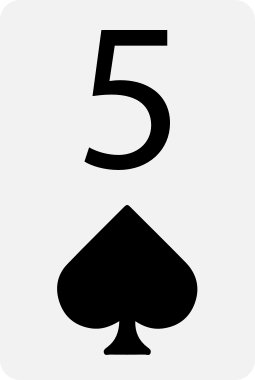
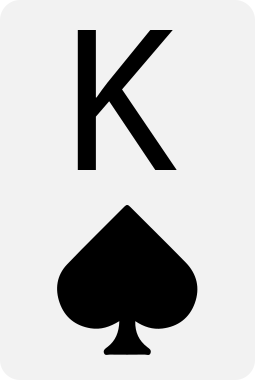
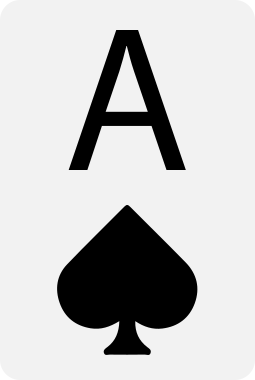
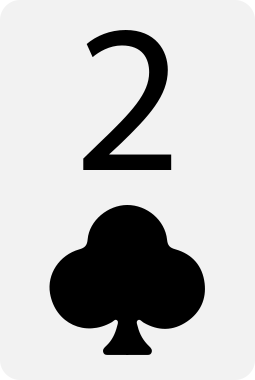
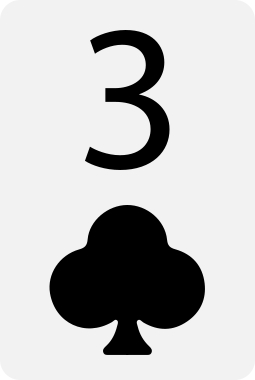
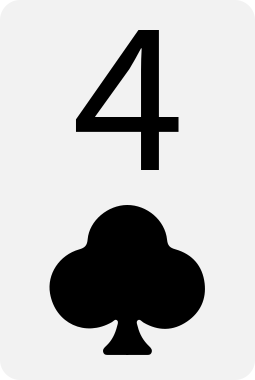
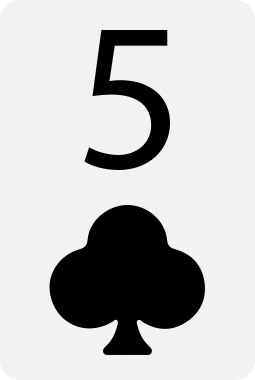
Five-Four offsuit is about as low as a connected hand gets. Both cards sit at the bottom of the rank ladder, the hand has no high-card value whatsoever, and it will be staring up at overcards on essentially every board it ever sees. And yet 54o occupies a unique position in poker hand discussions precisely because it is a true connector – no gap, maximum straight potential – at the lowest viable point on the card range. Whether that straight potential is enough to redeem it is the central question this page answers.
What These Odds Show for 54o
Start with the overcard table, because it defines everything else about how this hand plays. The chance of at least one overcard on the flop is 98.14%. By the turn it is 99.57%. By the river it reaches 99.91%. In practical terms, 54o will face at least one overcard on the board in every single hand it plays across any meaningful sample. There is no board texture planning around this – it is a constant.
That context makes the pair rate largely academic. The 42.73% chance of pairing by the river sounds reasonable until you remember that a pair of fours or fives on a board dominated by higher cards has almost no showdown value in a contested pot. Two pair at 22.27% is more interesting but still dependent on connecting with both cards, which requires a specific board configuration.
The number that justifies any discussion of 54o at all is the straight rate: 1.31% on the flop, 4.36% by the turn, and 9.18% by the river. That 9.18% is the highest straight completion rate of any hand covered on this page so far, and it is not a coincidence. As a true connector, 54o can form straights running ace through five, two through six, three through seven, four through eight, and five through nine – five distinct straight combinations, the maximum possible for any two-card holding. No hand with a gap can match that range of straight configurations, and that structural fact is the entire basis for 54o’s occasional playability.
The high card rate on the flop is 52.57%, the lowest of the hands covered here, which reflects how often the connected structure at least creates a draw even when it does not make a pair. By the river, high card falls to 17.15%.
Hand Strength Summary
- Hand type: Low offsuit true connector
- Relative strength: Weak – among the bottom tier of all starting hands
- Best case: Open-ended straight draw on a low board with implied odds
- Main vulnerability: Total overcard domination, no high-card fallback, no flush equity
54o has one job: make a straight. Everything else it produces is largely irrelevant in a serious pot. It is a hand that lives and dies by its draw equity and the implied odds available when that draw completes.
How Five-Four Offsuit Wins
54o wins in a narrow but occasionally effective set of circumstances:
- Completing a straight, ideally a non-obvious one that opponents do not see coming on a busy board
- Flopping two pair on a low board (e.g. 5-4-x) and getting paid by opponents with overcards
- Semi-bluffing an open-ended straight draw with eight clean outs and taking the pot before the draw completes
- Stealing blinds and dead money preflop from late position where no one has shown strength
The hand has essentially zero passive showdown value. At no point does 54o sit down at showdown and win with a pair or high card against a player who has invested meaningful chips across multiple streets.
Main Weaknesses
The overcard situation is not a weakness so much as a structural certainty. Planning around it is not possible – only accounting for it is. The other weaknesses compound it:
- Both cards are low enough that even two pair on a low board can be counterfeited by a higher two pair on later streets
- The offsuit nature removes all flush equity. The 1.95% flush rate by the river is entirely the board’s contribution
- A pair of fours or fives against any reasonable opponent range is almost certainly behind
- The ace-to-five straight (the wheel) is the lowest possible straight and is occasionally beaten by higher straights on the same board
- Multiway pots heavily dilute the implied value of the straight, since opponents are more likely to hold blocking cards or make stronger hands
Best and Worst Flop Textures
Strong flops
- 2-3 or 3-6 boards giving an open-ended straight draw – the primary target
- 6-7 or 7-8 boards where the hand picks up a draw to the higher end of its straight range
- A-2-3 boards giving a wheel draw, though opponents often recognise low straight boards
- 5-4-x boards for immediate two pair on a low texture
Dangerous flops
- Any board with two face cards – which is virtually guaranteed to occur across a session
- High paired boards where no draw is available and the hand has no pair or equity
- Boards with flush draws in play where 54o has zero redraws of that type
- Monotone or two-tone high boards where the only live equity is a gutshot or less
How It Plays by Position
- Early position: Never. 54o from early position at a full table is a leak regardless of how the session is going.
- Middle position: A fold in standard play. At a very short-handed or passive table, a limp might be defensible, but even then the hand is marginal.
- Late position: The only position where 54o has a legitimate case. On the button or cutoff in an unopened pot, it can be raised as a steal or flat-called to see a cheap flop with maximum straight potential. The five distinct straight draws justify a single investment for position.
- Blinds: In the big blind with favourable pot odds against a single late-position raise, 54o is a reasonable defend. The connectivity means it will flop a draw or a pair more often than many hands, and the pot odds make one street of investment acceptable. From the small blind, the out-of-position disadvantage erodes most of that value.
Common Mistakes with Five-Four Offsuit
The connectivity creates a specific set of traps for players who recognise the hand’s draw potential but overestimate how often it materialises. The most common errors are:
- Calling raises from multiple positions because the hand is a connector, ignoring that 9.18% straight completion still means missing nine times in ten
- Continuing on a flop with only a gutshot draw rather than an open-ended draw – four outs is not the same as eight
- Overvaluing a pair of fives or fours when the board is covered with overcards, which it almost always is
- Treating the wheel draw (A-2-3-4-5) as equivalent to a higher straight draw – the lowest straight is more easily beaten by higher straights and provides less implied value
- Playing the hand too passively when the draw does arrive, failing to extract value from the straight because opponents did not realise it was possible
Comparison to Similar Hands
- Stronger than: 5-3o and 5-2o, which have fewer straight combinations and even lower card values; 4-3o, where the range of straights is more limited
- Weaker than: 5-4 suited, which adds flush draw equity and makes the hand meaningfully more playable; 6-5o, which has a higher top card and less severe overcard exposure; 7-5o, where the one-gap still allows strong straight potential with a slightly higher ceiling
- Similar to: 4-3 offsuit – near-identical structure one step lower, with marginally fewer straight combinations
The gap between 54o and 54s is perhaps the most significant suit upgrade of any hand in this range. Suited connectors at the low end of the deck are genuinely playable hands in many situations. Their offsuit counterparts are niche at best. The flush equity added by the suited version transforms 54 from a one-trick drawing hand into a genuine multi-draw hand capable of flopping both straight and flush draws simultaneously.
How Five-Four Offsuit Performs in Multiway Pots
54o has a complicated relationship with multiway pots. The implied odds argument for playing small connectors is often made in the context of multiway action – more players means bigger pots when the straight hits. That argument has some validity, but several factors limit it for 54o specifically:
- The wheel end of the straight (A-2-3-4-5) is both the lowest straight and one opponents recognise quickly on low boards, reducing the amount paid off
- Low boards attract players with low connectors and suited cards, increasing the chance that straight outs are shared or blocked
- The complete absence of flush equity means opponents drawing to flushes have clean outs against you at all times
- If the pot becomes large multiway and 54o makes two pair rather than a straight, it is frequently behind a better two pair or a set
The ideal multiway scenario is a cheap flop, a strong open-ended draw, and a turn card that completes the straight on a board where opponents have made vulnerable top pairs they are unwilling to fold.
FAQ: Five-Four Offsuit
Is 54o actually playable or just theoretically interesting?
Both. It is theoretically the most connected offsuit hand at the low end of the deck. In practice it is a losing hand in most player pools when played too frequently, but it has a genuine role as a late-position speculation hand.
Why does 54o have more straight combinations than T7o?
Because it is a true connector with no gap, and because both cards sit in the middle of the straight-forming range. T7o has a three-card gap, which eliminates several straight configurations. 54o can contribute to five different straights; T7o significantly fewer.
Does the wheel count as a strong straight with 54o?
It counts as a made straight, but the ace-to-five straight is the lowest possible and can be beaten by any higher straight on the same board. On boards with 2-3-A or A-2-3, opponents familiar with low straight boards will be cautious about paying off.
Should you ever 3-bet with 54o?
Rarely and only as a pure bluff in specific spots – typically as part of a balanced 3-betting range from late position against a steal. It is never a value 3-bet.
Related Hands